Low keyword visibility
High-intent searches like "IT services for small business", "remote IT support services" and "managed IT support" all ranked beyond position 100 at the start of the engagement.


About the client
A US-based managed IT services and remote tech support company partnered with Crezeal to grow its organic search presence across the United States.
The company provides remote IT support for home users and businesses alike — covering computer repair, virus removal, network setup, cybersecurity, cloud backup and managed IT services. Based in Sheridan, Wyoming, it serves customers nationwide, with a 500+ customer base and a 5.0 Google rating.
Despite that service quality and review profile, organic visibility was not keeping up with the company's reputation. High-intent searches for IT support, managed services and computer repair across the US were not consistently returning the website in competitive positions. The goal was to fix exactly that: build keyword rankings, grow organic traffic, and establish durable search authority in one of the most crowded service categories in the US market.
The challenge
Ranking for IT support and managed services terms in the US means going up against large national IT companies, tech directories and review platforms — all with years of established authority behind them.
High-intent searches like "IT services for small business", "remote IT support services" and "managed IT support" all ranked beyond position 100 at the start of the engagement.
The site's authority was low relative to the established players dominating US IT support results, which made ranking difficult across every commercial keyword worth having.
With only a handful of referring domains early on, the site lacked the external authority signals needed to compete consistently in a national search market.
The business had no visibility in AI-driven discovery — ChatGPT, Google AI Overviews, Perplexity, Gemini or Claude — an increasingly important channel for how people find service providers.
500+ happy customers and a 5.0 rating, and a website attracting nowhere near the organic volume that record should command. The gap was visibility, not service.
Nothing here could be fixed quickly. Authority in a national service category is earned over months, not weeks — so the plan had to be built for compounding: technical health first, then content and links, with progress measured across a full twelve-month window rather than a single quarter.
The strategy
We built a structured, long-term SEO programme focused on improving keyword rankings across the US, growing domain authority, and earning visibility in both traditional and AI-driven search environments.
We opened with a comprehensive technical audit covering site speed, crawlability, indexation, structured data and schema markup. Closing those gaps first meant the site could be properly read, crawled and ranked by Google before any content or link work began.
A full keyword map was built around the client's core services — managed IT services, remote computer repair, IT support for small businesses, cloud backup and cybersecurity — combined with national and location-specific modifiers. Priority went to commercial terms used by home users and small business decision-makers actively looking for tech support.
Service and product pages were restructured for stronger keyword alignment, with improved meta titles and descriptions, a clearer content hierarchy and better internal linking. Content was written for AI readability at the same time, laying the groundwork for the citation visibility that followed.
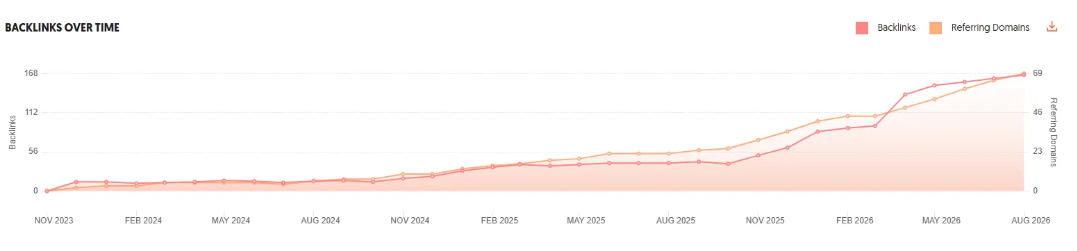
A consistent outreach-driven programme grew the backlink profile from a handful of referring domains to 168+ backlinks across 69 referring domains by August 2026. Domain Authority reached 11, on a steady upward trend from late 2023 onward rather than a short-lived spike.
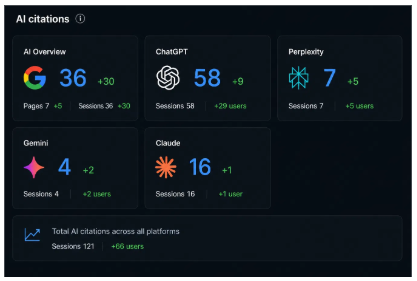
Alongside traditional SEO, we implemented answer engine optimisation — structuring content and schema to be discoverable inside AI-assisted search. That produced citations across Google AI Overviews, ChatGPT, Claude, Perplexity and Gemini: 121 sessions in total, bringing 66 new users from AI platforms alone.
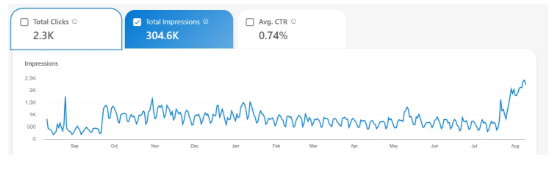
Parallel optimisation work was carried out for Bing, where the site recorded 304.6K impressions and 2.3K clicks — a meaningful secondary channel alongside Google, and one that matters more than most people assume for a US business audience.
The results
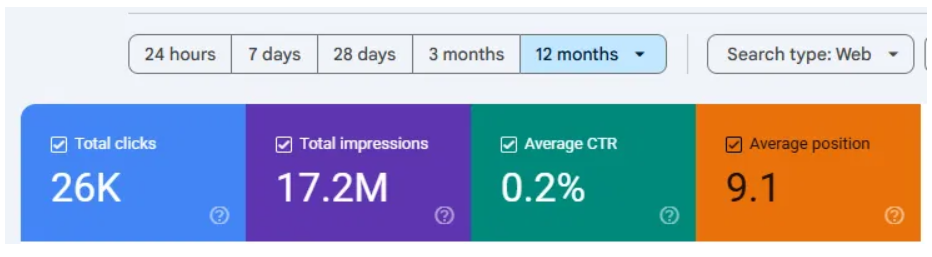
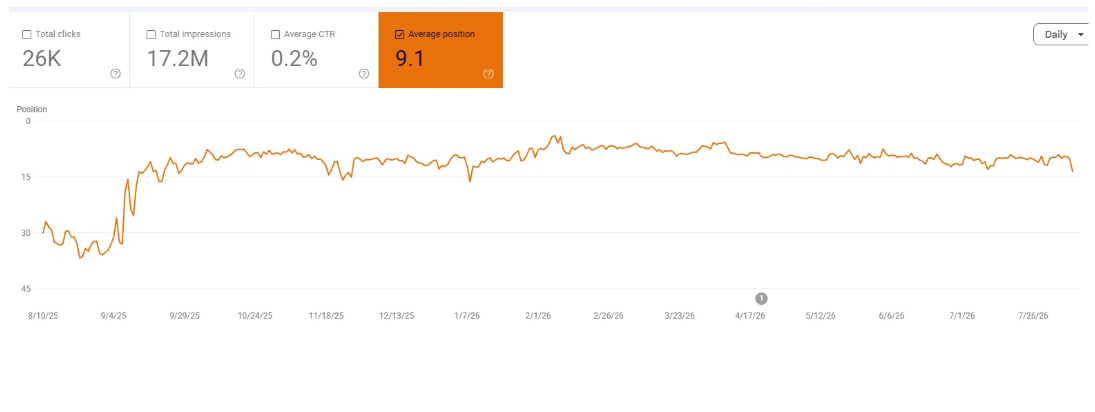
Over twelve months the site recorded 17.2M Google Search impressions and 26,000 organic clicks, with average position reaching 9.1 — placing it in or near the first page of results across a wide range of US IT support keywords.
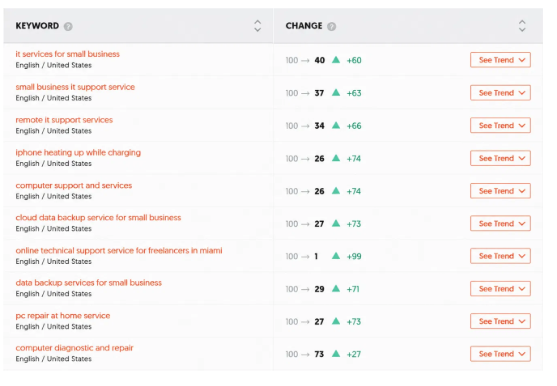
Keyword rankings improved sharply, with multiple terms moving 60 to 90+ positions in US English results. The backlink profile grew from near zero to 168+ links across 69 referring domains — a steady build from November 2023 through August 2026 rather than a spike. Domain Authority reached 11, with 3,500 organic keywords ranking, including 288 new keywords in the most recent reporting period.
GA4 recorded 5,600 active users and 5,200 new users at an average engagement time of 1 minute 14 seconds. Organic call tracking showed 85 call events from organic search, 66 of them engaged sessions — confirmation that the rankings were producing real customer enquiries rather than passing traffic.
| Keyword | Start | Now | Change |
|---|---|---|---|
| Online technical support service for freelancers in Miami | 100 | 1 | +99 |
| Cloud data backup service for small business | 100 | 27 | +73 |
| Remote IT support services | 100 | 34 | +66 |
| Small business IT support service | 100 | 37 | +63 |
| IT services for small business | 100 | 40 | +60 |
| Platform | Sessions | Share of total |
|---|---|---|
| ChatGPT | 58 | Largest single AI source |
| Google AI Overviews | 36 | Earned through schema and content structure |
| Claude | 16 | Growing assistant-led discovery |
| Perplexity | 7 | Research-intent queries |
| Gemini | 4 | Early-stage but rising |
| Total | 121 | 66 new users from AI-driven discovery |
17.2M impressions. 26,000 organic clicks. 3,500 ranking keywords. And 121 AI citation sessions from a site that started with no presence in AI search at all.
The proof
Pulled directly from Google Search Console, Google Analytics 4, Bing Webmaster Tools, Moz and our AI citation tracking. Client-identifying details are masked in line with our confidentiality agreement — the metrics themselves are unedited.



Screenshots are reviewed before publishing and any confidential information — client name, domain, account IDs — is masked or removed. The underlying performance data is accurate.
Key takeaways
17.2M impressions don't happen overnight. Steady monthly work on content, links and technical health built authority that accelerated over time — visible in the position chart's unbroken improvement from month one to month twelve.
121 sessions from ChatGPT, Claude, Gemini and others show that AEO is no longer optional. The structured content and schema work done for traditional SEO paid dividends in the AI discovery layer too.
3,500 keywords ranking, not one or two hero terms. That breadth gives the site resilience against algorithm changes and a much wider funnel of entry points for potential customers.
304.6K Bing impressions alongside the Google numbers show the value of optimising for both. For a US IT services audience — business users and older home users especially — Bing remains a meaningful channel.
85 organic call events confirmed the rankings were attracting people with real service intent, not casual browsers. For a business that sells through conversations, that is the metric that settles whether the other numbers meant anything — and quality of traffic matters as much as volume.
Crezeal builds SEO strategies that turn search visibility into real customer enquiries.
Get a free SEO audit →